13 October 2026
Reading a vessel's loaded state from hull colour alone
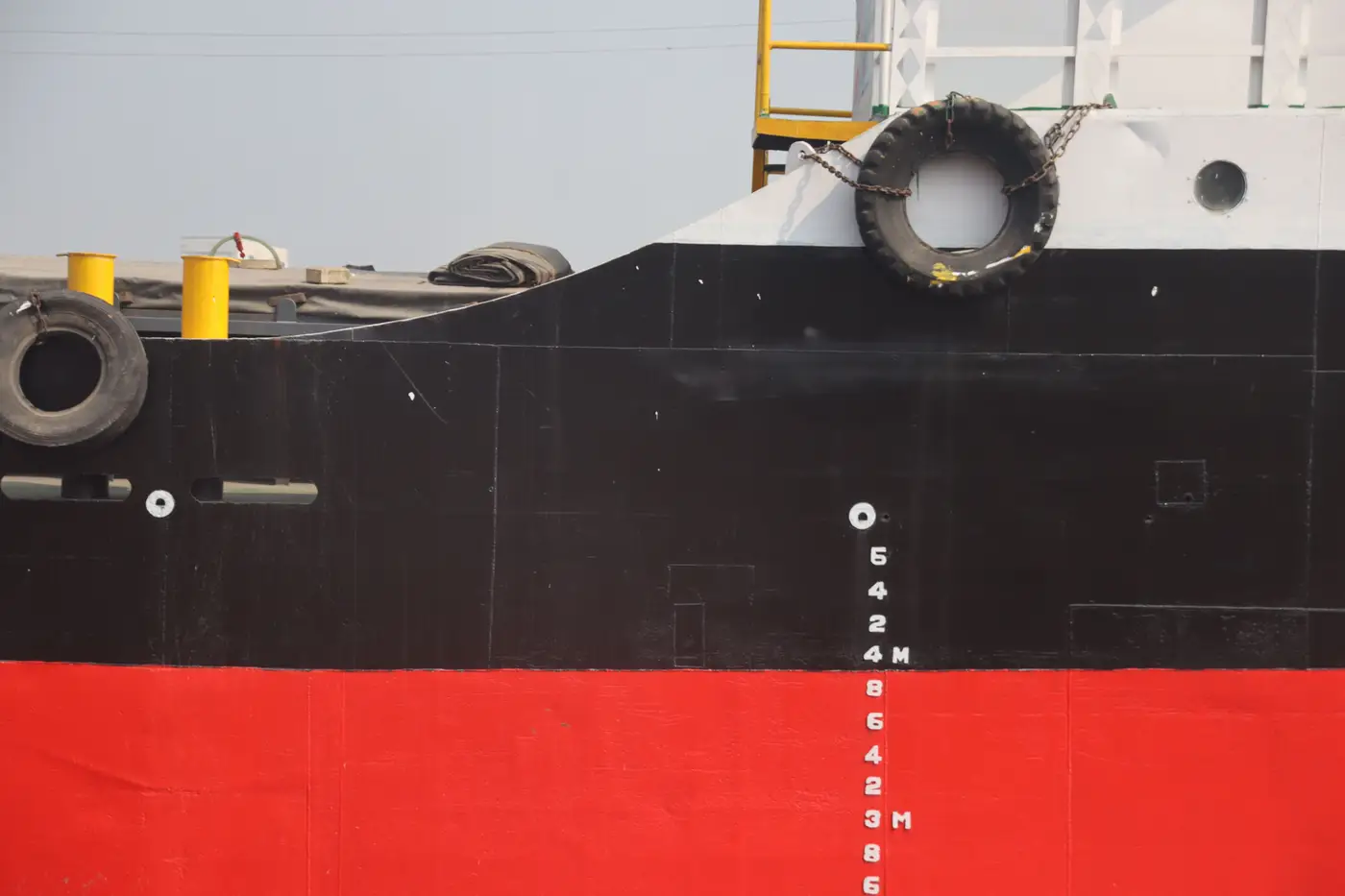
If you've ever pulled up a vessel photo on a tracking terminal and tried to guess loading state before the port call report lands, you've already used this method without naming it. The fastest visual read is the gap between the hull's two paint colours, not the deadweight tonnage sitting on the fixture note.
Most ocean-going vessels are painted in two bands. Below the design waterline sits anti-fouling paint, usually red, black, or a dark grey-green, there to slow barnacle and algae growth. Above it is the topside colour, often black, navy, or light grey, picked by the owner for looks more than function. The narrow strip where the two meet is the boot-top, painted at roughly the waterline the yard expects the ship to sit at most of the time, which in practice usually means somewhere near a loaded draft.
That boot-top band is the tell. On a laden vessel, most of it sits underwater. You see a thin sliver of anti-fouling, if any, and the topside colour runs close to the waterline. On a vessel in ballast, the ship rides high enough that the anti-fouling band shows as a wide stripe, sometimes a meter or more of exposed red or black hull, with the topside colour sitting well clear of the water above it.
Why the paint line isn't a precise draft reading
Treat this as a quick visual sort, not a draft number. A few things push the colour read off.
Biofouling darkens anti-fouling paint over months at sea, so a hull six months out of drydock won't show the same crisp red stripe as one fresh off the blocks. Some owners repaint the boot-top at a different waterline than the original design draft, which shifts where the band sits relative to actual load. Sun angle and sea state change how the imagery renders colour too. A wet hull under low morning light reflects differently than the same hull at midday, and a still photographed at a steep oblique angle will foreshorten the exposed band compared to one shot closer to broadside.
Hull type matters as well. A capesize bulker and a handysize product tanker don't carry the same freeboard-to-length ratio, so "high in the water" looks different on each. A stripe that reads as deep ballast on a small tanker might just be normal laden freeboard on a much longer hull.
What actually separates laden from ballast in a still image
Freeboard height measured against the vessel's known length and beam is the more durable signal, paint colour aside. Draft marks at the bow and stern give you an exact figure, but those require a close-range photo, usually from a tug, pilot boat, or port camera, not something available for a vessel mid-voyage.
From directly overhead imagery, at resolution fine enough to resolve the waterline against the hull, the useful measurement isn't the colour at all. It's the ratio of exposed freeboard to the vessel's overall length, calibrated against what's normal for that hull type. That's a steadier read than "does the red stripe look wide," and it's the one that survives a dirty hull, a flat grey sky, or a repaint job the owner never logged anywhere public.
A single still still only tells you one moment. The useful version of this is a weekly pass against the same vessel so you can see the waterline move, which is the problem Ship Loading State is built around: reading freeboard from overhead imagery on a cadence, flagged as laden, part-laden, or ballast, rather than squinting at one photo and guessing.
If you've got a vessel list you're tracking by eye right now, the pilot list is open.