2 November 2026
Part-laden vs fully laden: what the waterline tells you
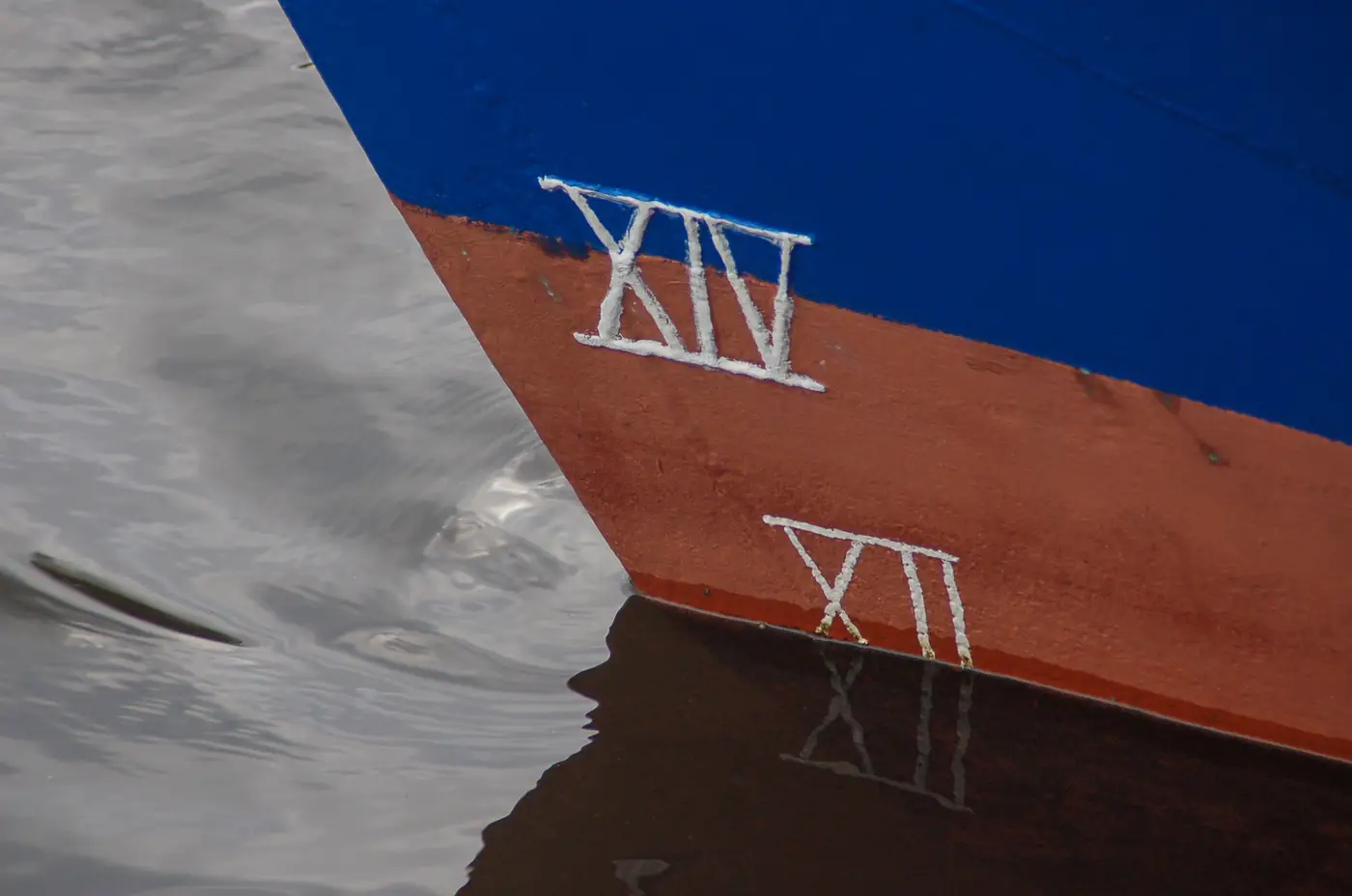
If you've spent any time staring at overhead stills of a bulker or a tanker trying to guess its state, you know it comes down to reading freeboard against the hull markings. The hull tells you something real, but only if you know which band of paint you're looking at.
Where to look on the hull
Every ship has a boot top, the band of contrasting paint (usually a darker anti-fouling color below, lighter topside color above) that marks roughly where the waterline sits across a normal range of drafts. When a vessel is in ballast, that boot top sits well clear of the water, often with a wide strip of red or brown antifouling exposed and fully visible from above. Fully laden, the waterline creeps up near the top of that band, sometimes submerging the lower edge of the hull markings entirely and leaving only a sliver of topside color showing.
Part-laden sits in between, and that's the problem for anyone trying to call it from a single frame. There's no fixed cutoff where "part" becomes "full." A vessel carrying 60% of her cargo doesn't show a waterline exactly 60% up the boot top. Hull form, parallel midbody length, and ballast tank arrangement all shift where the draft marks correspond to tonnage, and that relationship isn't the same for a Panamax bulker as it is for a VLCC or an LR2 product tanker.
What you're estimating from an image is freeboard: the vertical distance from the waterline to the deck edge or to a reference point like the main deck line. Compare that freeboard against the same vessel's known ballast and laden extremes, if you have a prior pass to compare against, and you get a reasonable read on where she sits now. Without a prior image of the same hull, you're estimating against a generic silhouette for that vessel class, which is a rougher call.
Why timing and trim can fool you
A vessel underway at speed throws a bow wave and squats slightly by the stern, which can make the forward freeboard look higher than it really is at rest. One doing bunkers or deballasting mid-port will show an uneven waterline between bow and stern, trimmed by the head or by the stern depending on what's being pumped. Read the image at the wrong moment in that sequence and you'll call a laden ship part-laden, or the reverse.
Light and sea state matter too. Low sun angle casts a shadow line along the hull that can be mistaken for the actual waterline, especially on a vessel with a dark hull color and little contrast at the boot top. Chop or swell blurs the waterline edge in anything but a very high resolution, very overhead frame, which is part of why this kind of read needs a clean near-vertical shot rather than an oblique angle.
When a part-laden call needs confirming
None of this replaces a draft survey or a bill of lading. What an overhead freeboard read gives you is a flag, not a certificate: laden, part-laden, or ballast, tied to the date of the image that produced it. That's useful on a desk tracking forty vessels against a trade flow story, where waiting on the next port call report or AIS draft message means waiting days you don't have. It's a different kind of evidence than a surveyor's tape measure, and it should be weighed that way.
If you're building this into a routine for a position you're tracking, a table that logs the flag against the image date each week is more useful than a one-off guess, because you can watch the trend rather than trust a single frame. That's the shape of the weekly loading-state read Ship Loading State is piloting against directly-overhead imagery, hull by hull.
If reading draft off freeboard sounds like something your desk does by eye already, the pilot list is open for exactly that use case.