9 November 2026
How to tell a product tanker from a crude carrier in satellite imagery
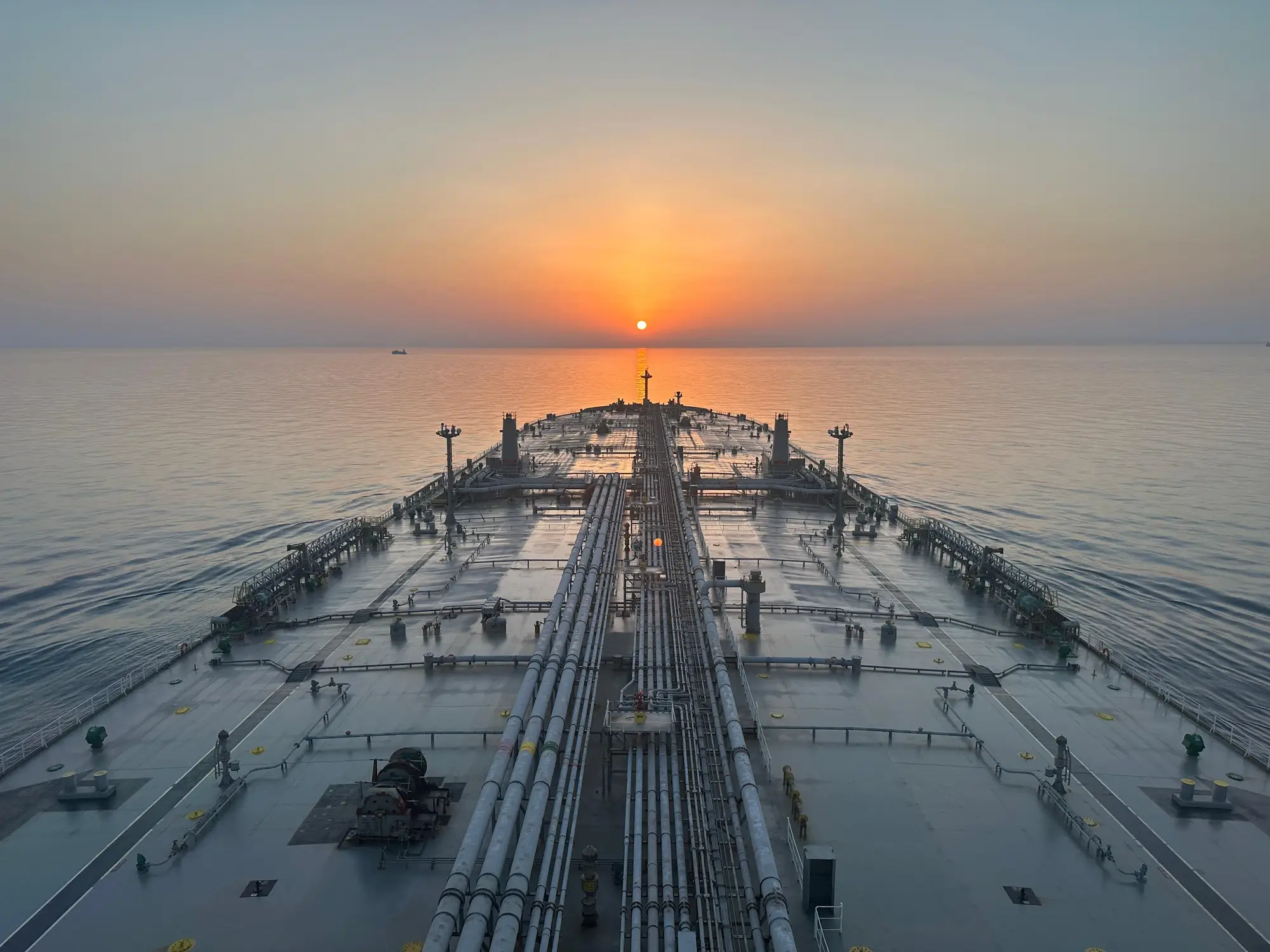
You've got a vessel on AIS with the transponder cut or the type field garbled, a chartering desk asking what it is, and nothing but a cloud-free overhead pass to work with. Length and beam from the pixel scale get you into the right size class. They don't tell you crude or product. For that you need to look at the deck.
Start with the manifold, not the hull
Crude carriers move one cargo, or close to it, in a handful of large tanks. The manifold reflects that: a compact cluster of large-diameter risers roughly amidships, usually with a single dominant loading arm connection point visible as a cross-shaped or T-shaped fitting. On a VLCC or Suezmax the manifold reads as a tight, simple knot of pipe against an otherwise clean deck.
Product tankers carry segregated parcels, sometimes six, eight, or more grades on one voyage, each needing its own line from tank to manifold so cargoes don't mix. That means more risers, more valves, and a manifold that spreads wider across the beam. At 0.5 m resolution, individual valves disappear into the pixel grid. What survives is the shape: a tight knot versus a spread-out comb of pipework. If the manifold footprint looks busier and wider than the hull size would suggest, lean product.
Deck layout and tank segmentation
Follow the deck forward and aft from the manifold. Crude carriers tend toward long, uninterrupted runs of flat deck between the manifold and the forecastle, because there are fewer internal bulkheads to express on the surface. You'll see pipe racks running fore-and-aft but not much cross-deck complexity.
Product tankers, especially MR and LR1 sizes built for parcel trades, show more visible segmentation: cross-deck piping at regular intervals, more frequent tank hatch covers, and often a coating-related detail, a slightly different deck color or sheen pattern from epoxy coating maintenance that crude hulls don't bother with. On a single still frame, you're pattern-matching one data point. Across a few hundred vessels, the read gets fast.
Size class helps narrow it further. Anything reading out as 330 m-plus LOA with that tight manifold signature is almost certainly crude, VLCC or ULCC, no product tanker runs that long. Below about 180 m with a wide, comb-style manifold, you're solidly in MR-product territory. The ambiguous band sits in the Aframax and LR2 range, 230 to 250 m, where both crude and product hulls exist and the external cues matter most.
Where this breaks down
Coated Aframaxes trading clean products look very close to their crude-trade sisterships from directly overhead. Sister-built hulls sold into different pools can carry nearly identical deck steel. A single still image, however sharp, won't show you valve-level detail that a port agent walking the deck would clock in ten seconds. Treat the visual read as a flag to narrow the candidate list against your fixture data and AIS history, not as a standalone type confirmation.
The same logic underlies reading loaded draft from freeboard: the geometry gives you a confidence level, shaped by hull type, deck layout, and trim. That's the thinking behind a weekly laden-or-ballast read built from overhead imagery, which flags loading state from freeboard and waterline without claiming to classify hull type outright. If your desk is already pulling overhead passes to narrow down vessel ID, the same imagery is worth a second look for whether that hull is sitting high or low in the water.
If tracking loading state without a port call report is a gap on your desk, the pilot list for Ship Loading State is open.