8 October 2026
What is squat effect, and why do laden vessels sit lower in shallow channels?
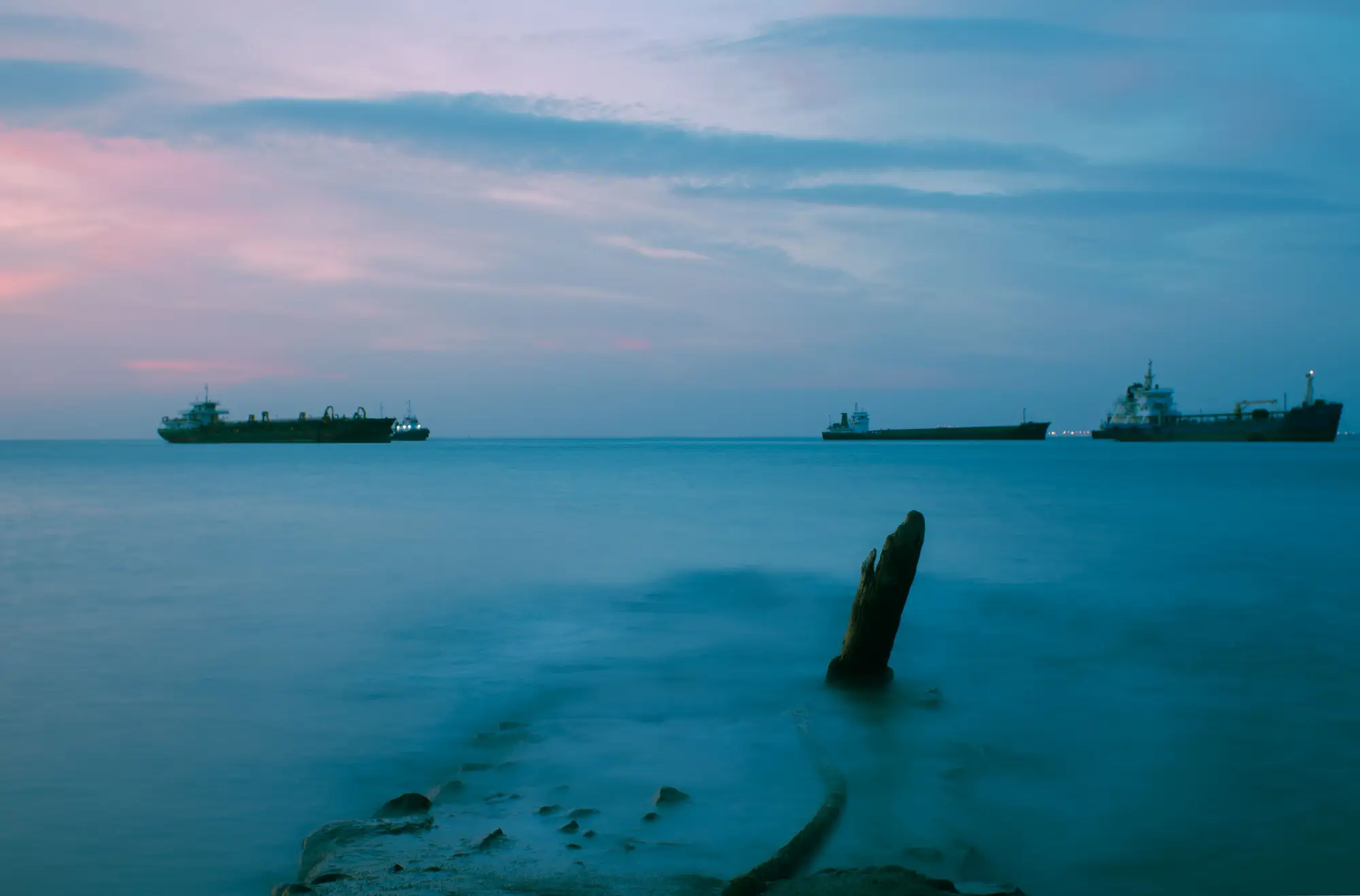
Anyone who's pulled up AIS on a Panamax working its way up a river channel has seen it: the vessel's reported draft creeps up a few decimetres compared to what the stowage plan said it should be, with no cargo change on either end. That's squat.
The mechanics, briefly
Squat happens because a moving hull pushes water out of the way, and in shallow or confined water that water has nowhere to go but faster, past the hull. Faster flow under the keel means lower pressure there, per Bernoulli. Lower pressure under the hull means the vessel sinks a bit and often trims, usually by the stern on a vessel with fuller lines aft. Stop the engines, and the squat goes away. Displacement doesn't change; speed through water and the ratio of water depth to draft are what's driving it.
Pilots and masters work this out before transit with squat tables or the UKC formulas built into passage plans, because a vessel that clears the bar with a metre to spare at anchor can touch bottom at eight knots in a narrow fairway. That's why speed restrictions exist on so many approach channels and why a loaded VLCC crossing a bar at neaps gets a speed cap that has nothing to do with traffic.
Why laden vessels feel it more
A laden vessel already has less underkeel clearance than the same ship in ballast, by definition: more cargo, deeper draft, less water between the keel and the bottom. Squat is additive to whatever draft the vessel started with, so a laden ship entering a shallow channel is working with a thinner margin before it ever picks up speed, and squat eats into that margin faster. A ballast passage through the same channel has more room to spare, which is part of why ballast legs tend to carry higher speed limits in pilotage directions than laden legs on the same route.
Reading loading state from a photo means accounting for this before calling a flag off one frame. A vessel caught mid-transit through a shallow approach can look marginally deeper than it would at anchor in deep water, purely from squat and trim, not from cargo aboard. It's a small effect at normal port-approach speeds, usually centimetres rather than the half-metre-plus freeboard swing between laden and ballast, but worth knowing the difference exists.
Squat versus loading state: two different questions
Squat answers "how is this hull interacting with the water column right now." Loading state answers "how much cargo is this vessel carrying." They move the draft in the same direction, deeper, but for unrelated reasons, and only one of them tells you anything about the cargo book. A vessel can squat two decimetres in a shallow channel and still be in ballast; a fully laden vessel at anchor in open water shows none of it.
Treat draft readings taken while a vessel is underway in shallow water as noisier than readings taken at anchor or alongside, and weight them accordingly when confirming laden versus ballast ahead of a report. The freeboard gap between a laden hull and a ballast hull is generally large enough to read past the squat noise, but a borderline part-laden call is exactly the kind of thing worth a second look rather than a single frame.
If you're trying to build a cleaner view of which vessels on your tracking list are riding laden, part-laden, or in ballast without waiting on the next port call, Ship Loading State is taking pilot signups for a weekly loading-state flag read from overhead imagery.