14 October 2026
What the Plimsoll line tells you about a vessel's loading state
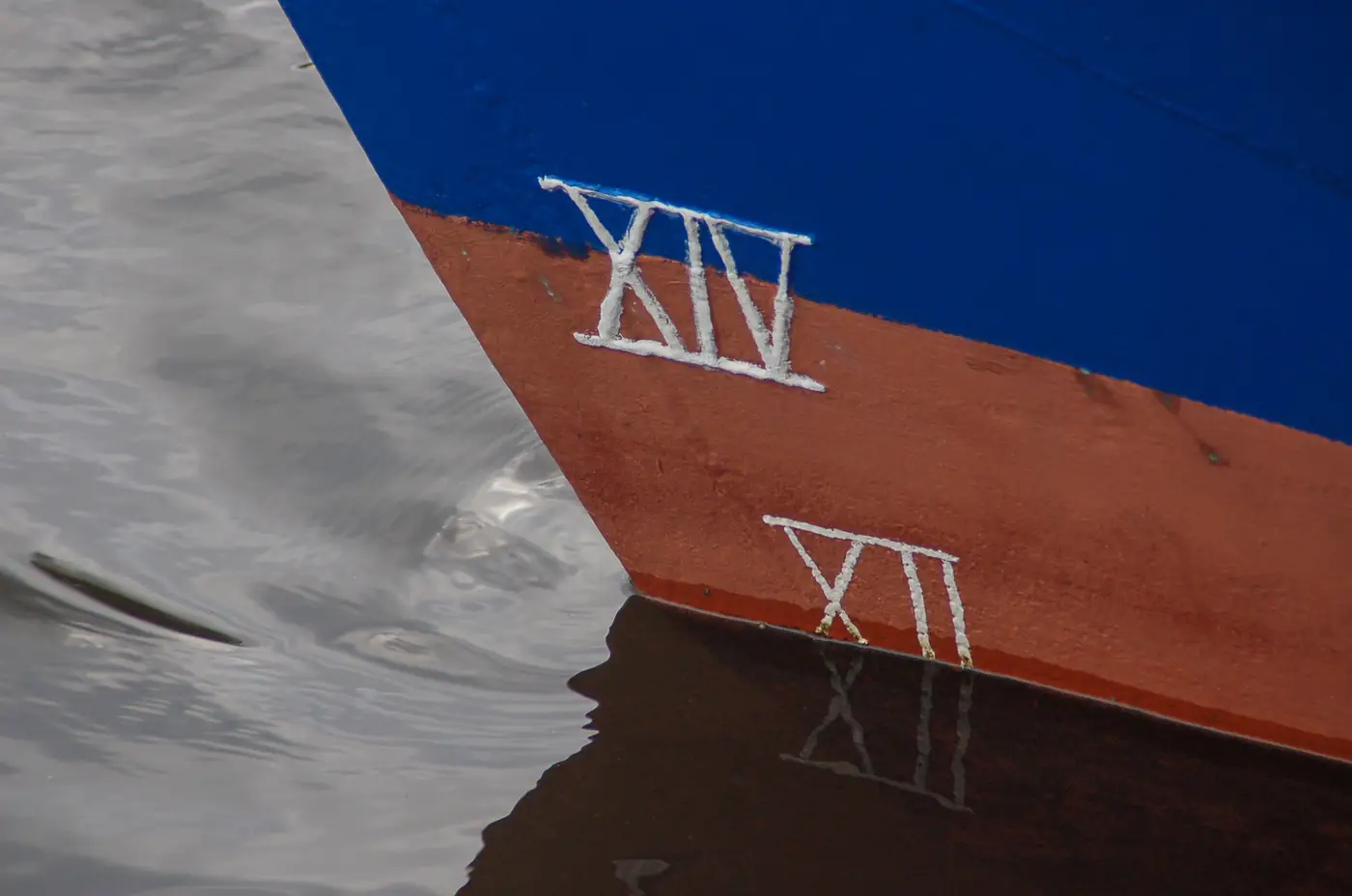
Every desk analyst who's spent time staring at AIS tracks and port call reports has run into the same gap: the ship's position tells you where it is, not what it's carrying. That's where the Plimsoll line comes in, and why it's worth understanding properly instead of just nodding along when a broker mentions it.
The Plimsoll line, plain and simple
The Plimsoll line is the circle-and-line mark painted on a ship's hull, named after Samuel Plimsoll, the British MP who pushed for it in the 1870s after one too many overloaded "coffin ships" went down with their crews. The mark sits at the point on the hull where the ship is allowed to sit in the water when loaded to its legal maximum, measured against a horizontal line through the center of a circle.
Next to the Plimsoll disc sits the load line mark itself, a short ladder of horizontal lines labeled for different water conditions: TF and F for tropical and fresh water, S for summer, W for winter, and WNA for winter North Atlantic. Each one accounts for water density and seasonal weather risk, since a ship riding at summer draft in the North Atlantic in January has less reserve buoyancy than the conditions call for.
None of this is decorative. The load line marks are set by classification societies and checked against the ship's International Load Line Certificate, a document every vessel over a certain size is required to carry. The certificate records the assigned freeboard, the vertical distance from the waterline to the freeboard deck, which is the uppermost complete deck exposed to weather and sea with permanently closed openings. More freeboard means more hull above the water and more reserve buoyancy if things go wrong. Less freeboard means the ship is sitting lower, closer to its limit.
Why this matters for reading loading state
Here's the part that lands on a trading desk. A vessel riding high, with a lot of freeboard showing and the ballast marks visible above the waterline, is almost certainly in ballast: empty or near-empty, moving to pick up cargo. A vessel riding deep, with the load line mark at or near the water and the hull sitting low, is laden, likely close to its cargo limit. Anything in between, part of the hull submerged but still showing a clear band of freeboard, suggests a part cargo.
This is the whole logic behind reading draft optically rather than waiting on AIS drafts, which masters don't always update, or a port agent's call. The freeboard-to-waterline ratio is a physical fact about the hull. It shows up directly in an overhead image if the shot is sharp enough and the angle is close to vertical, which gives you an independent read against whatever draft figure happens to be sitting in the AIS message.
The catch is that this only works cleanly if you know the ship's assigned freeboard to begin with, since a bulk carrier and a product tanker of similar length don't sit at the same line when empty, and hull form varies enough between classes that a flag from one hull type doesn't always translate cleanly to another. That's the part still being worked out across different vessel designs, and it's why reading draft from an image, rather than from a certificate or a dock report, is a different problem for every hull family.
What this looks like in practice
For a desk tracking a handful of vessels against a fixture or a freight curve, this usually means waiting for a port call update, a broker's word, or a draft survey report that lags the vessel's actual position by days. An image taken over the vessel at anchor or in transit can narrow that gap, flagging loaded versus empty well before the paperwork catches up, provided the shot is good enough to put a freeboard line against a hull.
If this is the kind of gap you're trying to close on a regular book of vessels, Ship Loading State is built around exactly that read: a weekly per-vessel loading flag built from overhead imagery, with the source image date attached so you know how fresh the call is. It's early access right now while the hull-type question gets worked through properly, but the pilot list is open if you want a seat at the table.